
Question:
We cannot completely avoid conflict. It arises naturally from differences in opinion, as each individual carries a unique perspective. Yet, it is also advised to avoid conflict-causing individuals, as they drain energy and consume time. How, then, should we approach conflict?
Answer:
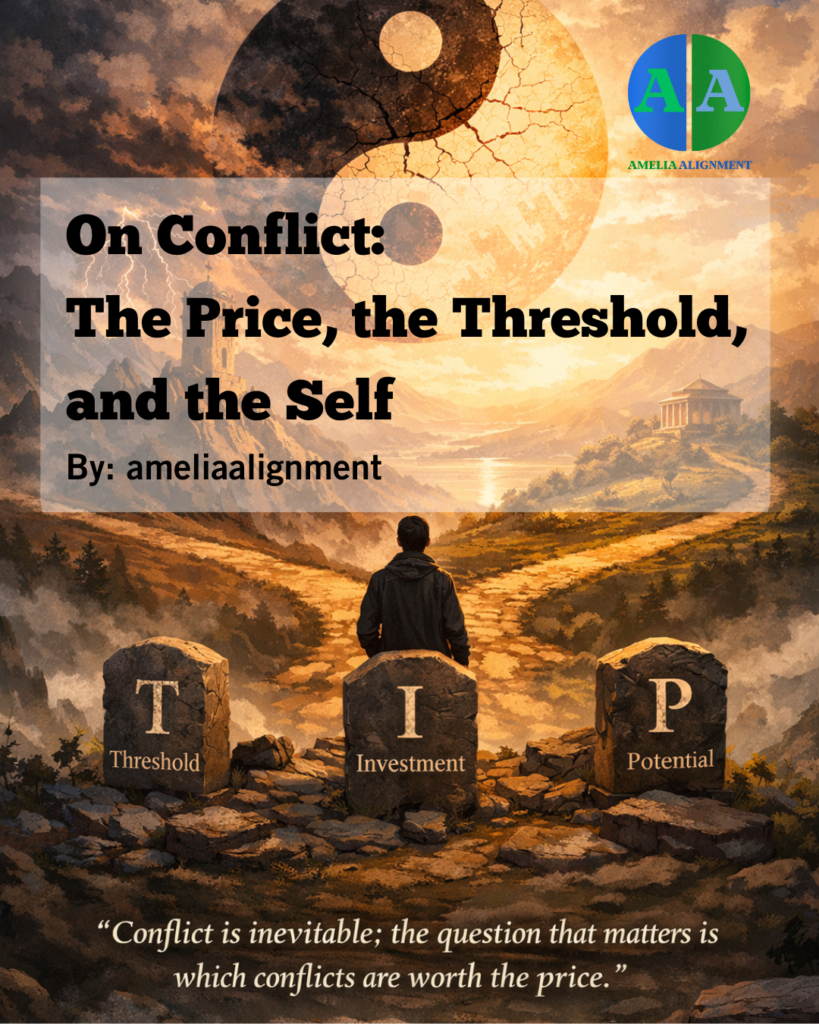
“Conflict is inevitable; the question that matters is which conflicts are worth the price.”
I begin by affirming both positions—equally and without contradiction.
Conflict cannot be avoided. It is, by definition, the active tension between differing principles, perceptions, or interpretations. No two minds are identical. Even within the intimacy of a family, divergence is inevitable. Even between twins, difference persists.
And yet, it is also true that conflict should be avoided.
This is not a contradiction, but a matter of threshold.
There exists a form of conflict that remains within tolerance: minor disagreements, differences in taste, variations in preference. These are not only unavoidable, but harmless. To expend energy avoiding such conflicts is itself wasteful.
However, there is another form—conflict that exceeds one’s capacity to bear it. Conflict that drains, distorts, and consumes. This, without hesitation, should be avoided.
The Problem of Tolerance
At this point, a more difficult question emerges:
What does it mean for conflict to be tolerable?
And what, precisely, is being tolerated—the conflict itself, or the person who generates it?
Tolerance is not a fixed measure. It is deeply subjective.
An open-minded individual may endure a wide range of disagreements without disturbance. Another, more rigid or temperamental, may find even minor divergence unbearable. What is trivial to one may be intolerable to another.
Because of this subjectivity, one requires not a rule—but a method of discernment.
The T.I.P. Test
To navigate this ambiguity, I propose a simple reflective framework: the T.I.P. Test.
It is not a formula, but a lens through which one may evaluate whether a conflict deserves engagement.
T — Threshold (Values)
Does this conflict violate your ethical or emotional boundary?
If engaging requires the abandonment of your principles or inner equilibrium, withdrawal is not weakness—it is clarity.
I — Investment (Cost)
What will this conflict demand of you—time, energy, attention?
If the cost outweighs any meaningful return, the engagement is unjustified.
P — Potential (Growth)
Is there genuine possibility for understanding, refinement, or truth to emerge?
If so—and only if the previous conditions remain within tolerance—then engagement may be warranted.
This framework does not eliminate conflict. It clarifies your relationship to it.
It allows you to step in, step back, or step away—without confusing avoidance with wisdom, nor engagement with strength.
The Human Variable
Ultimately, conflict returns us to a more personal question:
What kind of person can you tolerate?
Because conflict is rarely abstract—it is embodied in people.
Some individuals prefer openness, fluidity, and dialogue. Others are drawn toward rigidity, certainty, or even confrontation. There are those who avoid conflict entirely, perhaps shaped by past experiences where conflict signaled danger, instability, or violence.
For them, even minor disagreement may feel like the beginning of something destructive.
Yet, there are also those formed under similar conditions who arrive at the opposite conclusion—becoming not avoidant, but accustomed to conflict, even reliant on it.
Here lies a dangerous intersection:
When those who fear conflict meet those who thrive within it, escalation becomes almost inevitable.
The Paradox of Opposition
From this, a deeper insight emerges:
One origin can produce two opposing outcomes.
And when these outcomes confront each other, each perceives the other as fundamentally different—while, in truth, they arise from the same root.
In such moments, both sides become blind. They no longer seek understanding; they only know how to oppose.
This is why an old proverb warns:
“Do not engage in conflict with immoral people, for you may become like them.”
The warning is subtle but severe.
To oppose something is to risk mirroring it.
To fight on corrupted terms is already to concede.
If the methods required to win a conflict demand the abandonment of your own standards, then the loss has already occurred—regardless of outcome.
When Conflict Cannot Be Avoided
And yet, reality does not always grant us the luxury of withdrawal.
There are moments when conflict becomes inescapable—when one is already entangled despite every attempt to avoid it.
Here, another distinction becomes important:
If a conflict is tolerable, the issue may lie with the person.
But if it becomes intolerable—and you cannot leave—it is no longer about the person. It is about the conflict itself.
And in such cases, avoidance is no longer an option.
Resolution becomes necessary.
A Final Reflection
For those who instinctively avoid conflict, especially those already trapped within it, there is something worth understanding:
Not all individuals are diminished by conflict.
Some are animated by it.
In the absence of tension, they stagnate. In the presence of opposition, they sharpen.
While it is not necessary to adopt their disposition, understanding their orientation allows you to see conflict from another angle—not merely as disruption, but as a force that, under certain conditions, produces clarity.
Like suffering, conflict has another side.
And that other side, though often concealed, may resemble something close to growth—or even a form of quiet satisfaction.
This discussion, however, is not complete.
Conflict is one of those subjects that resists closure. It expands the more it is examined, revealing new layers, new tensions, and new interpretations.
So if something here still feels unresolved, that is not a flaw—it is an invitation.
We will return to it again, from another angle, with different questions, and perhaps, a deeper understanding.
Disclaimer:
This article is for reflective and educational purposes only. It does not constitute professional advice of any kind.
The concepts presented, including the T.I.P. framework, are intended as tools for personal discernment and may not apply universally. Readers are responsible for their own interpretation and application.
For serious conflict, distress, or risk-related situations, professional support is strongly recommended.