
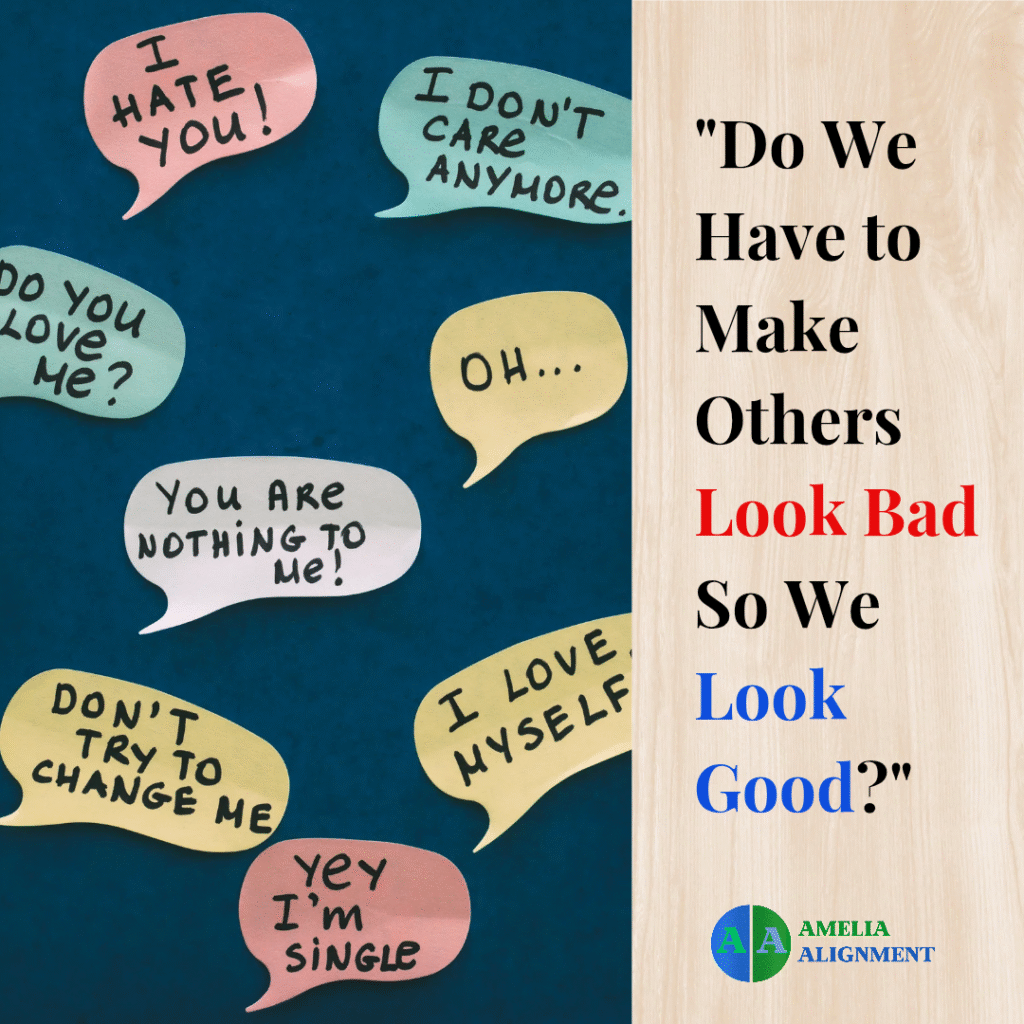
Question:
I often see this online. Whether on websites or social media, people introduce themselves by badmouthing others—yet in the end, it’s merely a way to promote themselves. Even when it’s not directed at me (they just badmouth their rivals), I still find it unpleasant. Anything that diminishes another person tends to make me uncomfortable.
You feel it right. Even when someone doesn’t offend us directly, it would still make us uncomfortable, because of the “bad” energy they spread.
Yet this phenomenon is remarkably common. Not only on the internet or social media, but also in everyday conversations and casual talk. We can easily find people who try to elevate themselves by putting others down.
To be honest, I don’t understand how such people think. After all, we know that it is our duty to respect and appreciate others. There’s a famous saying: “Treat others as you would like to be treated.” Furthermore, many conflicts and arguments arise precisely because some people cannot accept being bad-mouthed, become angry and retaliate to those who badmouth them. Then, it’s also possible for someone to rise even higher when they are badmouthed, slandered, or belittled—causing backlash for those who badmouth them.
But people who engage in this kind of behavior seldom realize it. That’s why, this kind of behavior persists.
Then the question arises; why do they not realize it?
On a subconscious level, many people seem to believe that the quickest way to advance is by dragging others down—especially those they see as “obstacles.” They assume their rivals are ahead, and unless they discredit them, they’ll remain behind. If they can destroy another’s image, they feel they’ve moved forward. That’s how the subconscious mind often works.
There’s another side to the human psyche: many are drawn to the negative. When we speak positively about ourselves, few people are interested. But if the conversation turns to someone’s flaws or failures, suddenly everyone listens. Because marketing success isn’t easy, people often resort to what feels like the “easiest” strategy among difficult ones—discrediting others.
I used to be annoyed by these people. Honestly, even now, I still feel uncomfortable everytime I find this behavior. Especially because I know their motive for badmouthing others is for self-serving. And I’ve encountered so many of them in my life—too many to count. For a long time, their presence irritated me. But as time goes by, that irritation transformed into something else: Curiosity.
Yes, I’ve become curious about such people.
There are many ways to compete healthily—without denigrating others. One simple way is to focus on improving ourselves. That, too, is a form of winning. So why do some still choose to badmouth their rivals, even without evidence? Do they ever consider that they themselves have flaws? What if the person they target becomes angry and retaliates? And what if, in truth, their own flaws are greater than their rival’s—wouldn’t it be even more humiliating if those flaws were exposed?
That’s why I now choose to observe people like this. At first, it wasn’t easy—my emotions often overpowered my reasoning. Perhaps this is also why people enjoy negative talk: it triggers emotional reactions instantly.
Emotional processing is rapid and closely tied to survival. It often influences our behavior more strongly than rational thought. Subconscious or implicit emotions can shape our decisions, memories, and actions even more powerfully than deliberate reasoning.
In their paper “An fMRI Investigation of Emotional Involvement in Moral Judgment,” Greene, Sommerville, Nystrom, Darley, and Cohen found that moral dilemmas evoking strong emotional conflict (like pushing one person off a bridge to save others) activate emotional brain regions and lead to slower, more conflicted decisions. This research shows how emotion can override utilitarian logic.
Daniel Kahneman’s Thinking, Fast and Slow also explores this beautifully. He describes System 1 (fast, automatic, emotional) and System 2 (slow, deliberate, logical)—showing how the fast, emotional system often dominates, even when it leads us astray. Emotional intuition frequently drives real-world decisions—in finance, health, and relationships. Many other works echo this dynamic between emotion and reason. It’s a topic worth exploring in greater depth another time.
Interestingly, people who badmouth others seem to know how to manipulate emotions instinctively—without ever reading a single research paper. And those who react to them emotionally are, at that moment, not thinking critically or rationally. Because, rational people can still fall into emotional traps, especially when tired or overwhelmed. That’s why content that attacks others spreads so easily. When it circulates by word of mouth, it’s called “hot gossip.” When it spreads online, it becomes “viral content.”
Has observing them helped me understand how to respond? Somehow, it works. There are many methods people suggest for handling such individuals, and many are said to be effective. Yet, this phenomenon never disappears—it simply takes new forms as we move through different phases of life.
Still, I find that choosing to observe helps me far more than reacting emotionally. Why?
Because people like this thrive on emotional responses—especially from those they target. When we react, we feed their intent. That’s why I try not to give them what they want. Instead, I observe.
Observation helps me recover my clarity, my reason, and my calm.
Of course, there are moments when I’m exhausted, when my stamina runs low, and thus, I get swept into emotion. But, I am not always tired—and thus, certainly not always defeated.
References:
1. Greene, J. D., Sommerville, R. B., Nystrom, L. E., Darley, J. M., & Cohen, J. D. (2001). An fMRI investigation of emotional engagement in moral judgment. Science, 293(5537), 2105–2108. https://doi.org/10.1126/science.106287
2. Kahneman, D. (2011). Thinking, fast and slow. New York, NY: Farrar, Straus and Giroux.