
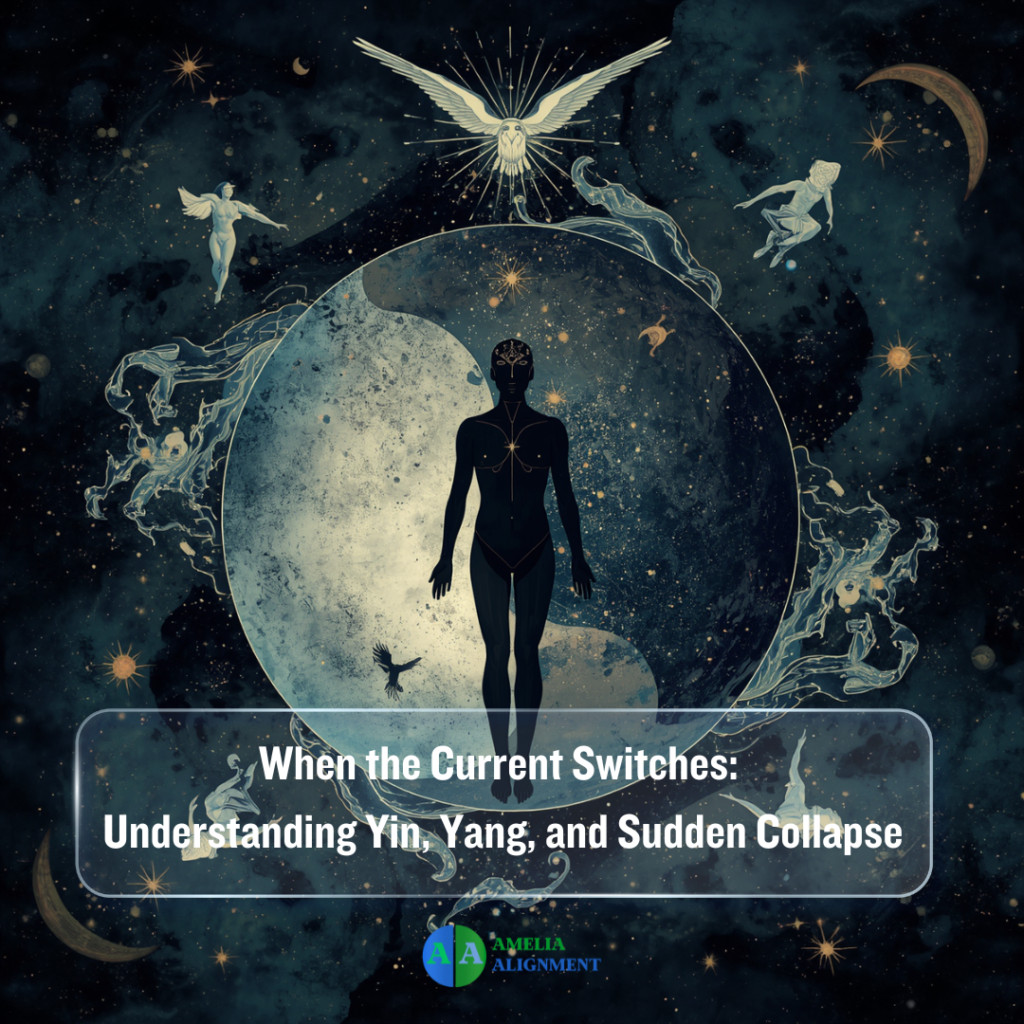
When we are active, enthusiastic, diligent, and striving, we are in a Yang phase. Conversely, when we relax, pause, or rest, we are in a Yin phase.
Ideally, Yin and Yang remain balanced. Yet, we often have a tendency to gravitate toward extremes: extreme Yang or extreme Yin. We tell ourselves: If you’re active, stay active. If you’re working, keep working. Or conversely: If you’re relaxed, stay relaxed. If you’re resting, remain idle.
Naturally, the body is capable of stabilizing Yin and Yang without conscious effort. After a period of hard work, the body grows tired, prompting rest. Once rested, our energy is replenished, and we are ready to resume activity. This is evidence that our bodies possess an innate ability to self-regulate this balance.
However, we can override this natural process.
We might command the body to sustain Yang energy—to keep working—even when it has clearly entered a Yin phase requiring rest.
Is this permissible? Yes, because the flow of Yin and Yang is not a rigid mandate. We think, “Just this once.” Occasional deviation from the natural rhythm is, indeed, acceptable.
The danger lies in how easily an exception becomes a constant state. We break the “once in a while” rule repeatedly, drifting further from the body’s natural cadence, until we find ourselves unable to rest even when we desperately want to. We want to sleep, but the mind refuses to quiet; it keeps spinning. Have you experienced this?
There is another principle to understand: Yin and Yang can undergo drastic transformation. Yin can abruptly turn into Yang, and Yang can collapse suddenly into Yin—without warning and beyond our control.
A sudden illness or fainting spell in a previously healthy person exemplifies this extreme, rapid shift from Yang to Yin. Viewed in isolation, this is frightening. How can a vibrant person suddenly fall ill? Could it happen to me?
But it is crucial to recognize this as an anomalous, extraordinary situation. Under normal circumstances, shifts are gradual, subtle, and predictable—much like the natural transition from work to rest.
Why, then, do these sudden shifts occur? Typically, it is because Yin (or Yang) has been pushed to an extreme state. When the body is subjected to constant work and relentless fatigue (excess Yang) without the counterbalance of rest (Yin), it becomes vulnerable to this volatile, extreme shift.
So, if you find your mind racing when you should be resting, be mindful of the potential for a sudden and harsh correction. And perhaps consider this question: What conditions preceded this state? Is it possible you have violated the “once in a while” boundary so frequently that it has become the new normal?
If so, that habit must be adjusted. We must allow our bodies to determine which phase they naturally need to enter, on their own terms.
Addiction to the Pull
If we fail to restore balance early enough, the body can become “addicted” to either the pull of Yin or the pull of Yang, depending on our dominant state.
-
Constant engagement in the working (Yang) phase can lead to addiction to perpetual activity—what we commonly call workaholism.
-
Constant indulgence in the resting (Yin) phase can create an addiction to inertia. This is the root of the familiar complaint: “You’re so lazy! All you do is lounge around and sleep!”
And generally speaking, rebalancing Yin and Yang becomes profoundly difficult once this “habit phase” has taken hold.
Disclaimer: This article reflects my personal reflections and opinions. The views expressed are my own and are based on my individual experiences and perspectives. They are not intended to represent universal truths, professional advice, or the views of any organization or individual.
Image was created using AI to visually express the ideas explored in this article.