
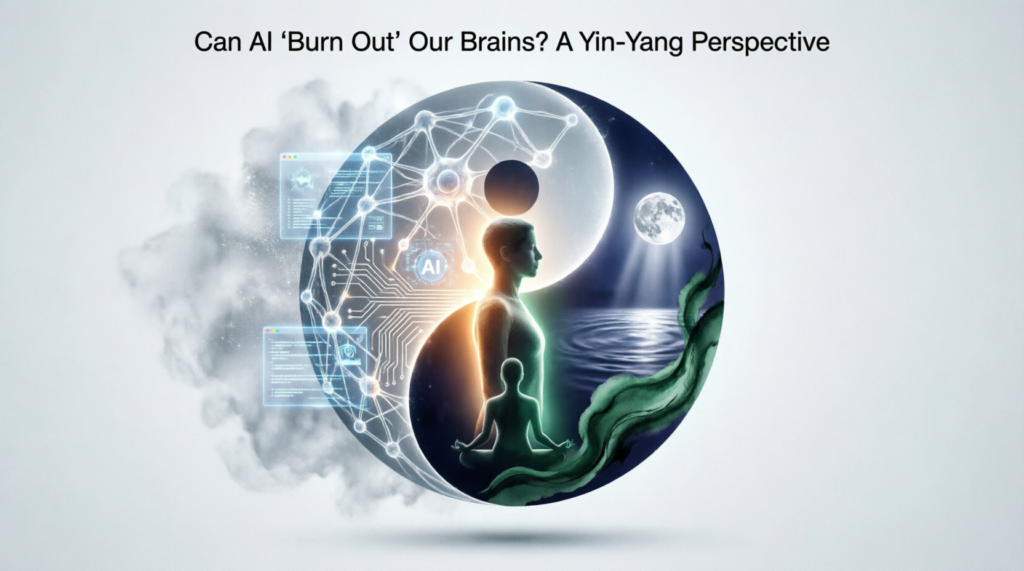
Despite promises of enhanced efficiency, artificial intelligence is increasingly linked to cognitive fatigue and decision-making paralysis among knowledge workers. This is the phenomenon of “AI brain fry,” characterized by mental fog, excessive oversight burdens, and eroded confidence.
But, what if we take the perspective view from another side? In this case: the ancient framework of Yin-Yang Philosophy?
Here, I try to categorize intensive AI usage as an excess of “Yang” energy and propose restorative “Yin” practices as a necessary counterbalance. The result is a strategic approach to sustaining productivity while safeguarding mental well-being in the age of automation.
The Paradox of Efficiency
Artificial Intelligence was promised as the ultimate tool for efficiency—a way to simplify work and amplify human potential. Yet, a growing number of workers report the opposite effect. Instead of feeling liberated, many describe a phenomenon akin to “AI brain fry”: increased cognitive load, overwhelmed attention, and profound mental fatigue.
The Evidence: What the Data Says
A study conducted by Julie Bedard and her team, published in the Harvard Business Review, sheds light on this emerging issue. The researchers surveyed 1,488 full-time U.S.-based workers across various industries, roles, and levels (roughly split between men and women, with a mix of individual contributors and leaders). They examined patterns of AI use alongside cognitive and emotional states.
The results were telling. Participants reported physical and mental symptoms including a “buzzing” sensation, mental fog, difficulty focusing, slower decision-making, and headaches.
Key Findings: The Cost of Oversight
The study highlighted two primary drivers of this strain:
1. Intensive Oversight: Modern workers often manage multiple AI systems simultaneously, ranging from research assistants to code generators.
2. Context Switching: Juggling numerous AI tools requires managing multiple windows and interfaces, which fragments attention and leads to rapid mental fatigue.
The Human Experience: Confidence vs. Doubt
Beyond the statistics, the qualitative feedback reveals a deeper psychological toll. Senior technical managers and financial directors echoed sentiments heard across the participant pool:
- The Confidence Gap: While AI assists with evaluating decisions, summarizing data, and generating ideas, workers do not feel smarter. Instead, they report a nagging sense of “I don’t know what I’m doing.”
- The Double Burden: The duty of work is effectively doubled; employees must not only do the task but also rigorously double-check the AI’s output.
- Cognitive Clutter: This verification process creates impatience and mental clutter. Workers struggle to make sense of the information, leading to self-doubt.
- The Reset Cycle: Often, employees find they must step away and review the work again only when their mind is clear, negating the time saved.
The mental strain associated with this dynamic comes at a significant cost: increased employee errors, decision-making fatigue, and a heightened desire to quit.
A Philosophical Lens: The Imbalance of Yang
While AI is a new variable, the physiological response is not. Many demanding tasks produce a similar “brain fry” effect. In the context of ancient Chinese philosophy, these activities can be classified as Yang.
- Yang encompasses energy that is increasing, rising, expanding, and active. In the modern workplace, Yang-dominant activities include:
Workaholism and overwork. - Chronic lack of sleep.
- Excessive meetings.
- Aggressively chasing promotions or metrics.
When AI is added to this mix, it accelerates the pace and volume of output, further intensifying the Yang energy. If pursued too aggressively, the outcome is inevitable: a state of excess that resembles “AI brain fry.”
The Remedy: Activating Yin
According to Taoist philosophy, the way to balance a drastic rise in Yang is to shift toward Yin.
Yin is the complementary opposite of Yang. It encompasses rest, calmness, relaxation, slowness, and internal reflection. After a period of working too hard (becoming too Yang), it is essential to “pause for a moment” and activate Yin, even briefly.
This is not a suggestion to eliminate Yang entirely. We are not advocating for avoiding AI, doing no work, or living only in idleness. In the philosophy of Yin and Yang, extremism in either direction is harmful. The goal is homeostasis.
Practical Ways to Restore Balance
To counteract the Yang intensity of AI-driven work, consider integrating these Yin practices:
- Rest and Sleep: Prioritize genuine downtime.
- Meditation: Practice mindfulness to clear mental clutter.
- Appreciation: Take time to acknowledge and appreciate the results of your work.
- Gratitude: Cultivate happiness toward yourself every time you complete a task.
- Nature: Take a leisurely walk in the park to ground your energy.
Conclusion: Adaptation and Balance
The key is to do everything in balance.
There is also a modern psychological layer to consider: “AI frying the brain” may occur simply because the human brain has not yet fully adapted.
AI is a nascent phenomenon, and the transition from old workflows to new ones is inherently exhausting.
Letting go of the familiar to adapt to the new demands a heavy toll, both physical and mental.
By recognizing the Yang nature of this technological shift and consciously inviting Yin into our daily routines, we can protect our cognitive health while navigating the future of work.
And.
To embrace Yin is:
To accept our human limits.
To find redemption in the pause.
And, to save the soul from the grinding machinery of progress, before it is too late.
Disclaimer:
This article is for informational purposes only. Not medical or professional advice. Study interpretation and philosophical framing are the author’s own. Individual experiences with AI vary. Consult original research and qualified professionals for personalized guidance.
Image was created using AI to visually express the ideas explored in this article.
Reference:
Bedard, Julie, Matthew Kropp, Megan Hsu, Olivia T. Karaman, Jason Hawes, and Gabriella Rosen Kellerman. “When Using AI Leads to ‘Brain Fry’.” Harvard Business Review, March 5, 2026. https://hbr.org/2026/03/when-using-ai-leads-to-brain-fry.